
ERPC Brings the Entire Platform to 16 Languages — Use the Solana RPC Website and Dashboard in Your Native Language
ERPC Brings the Entire Platform to 16 Languages — Use the Solana RPC Website and Dashboard in Your Native Language
ELSOUL LABO B.V. (Headquarters: Amsterdam, Netherlands; CEO: Fumitake Kawasaki) and Validators DAO, the operators of ERPC, are pleased to announce that the entire ERPC platform is now available in 16 languages worldwide. Developers can review, order, configure, and manage Solana RPC across the official website and dashboard in their native language.
With this update, developers and operations teams using ERPC can complete the full workflow — comparing Solana RPC plans, obtaining API keys, configuring endpoints, monitoring usage, and creating support tickets — in any of the following 16 languages: English, Japanese, Simplified Chinese, Traditional Chinese, Russian, Korean, Vietnamese, Thai, Indonesian, Hindi, Turkish, Dutch, German, French, Spanish, and Portuguese.
When choosing and configuring the infrastructure that best fits your work, you deserve tools that are smooth, clear, and easy to operate in your native language. ERPC works on platform speed every day, and we treat the user experience across the entire platform with the same level of care.
This update is available to everyone already using ERPC. No additional plan, contract change, or configuration step is required — simply switch languages from the language selector on the official website or in the dashboard.
ERPC Dashboard: https://dashboard.erpc.global/en/
ERPC Official Website: https://erpc.global/en/
Available in 16 Languages — Across the Official Website and the Dashboard
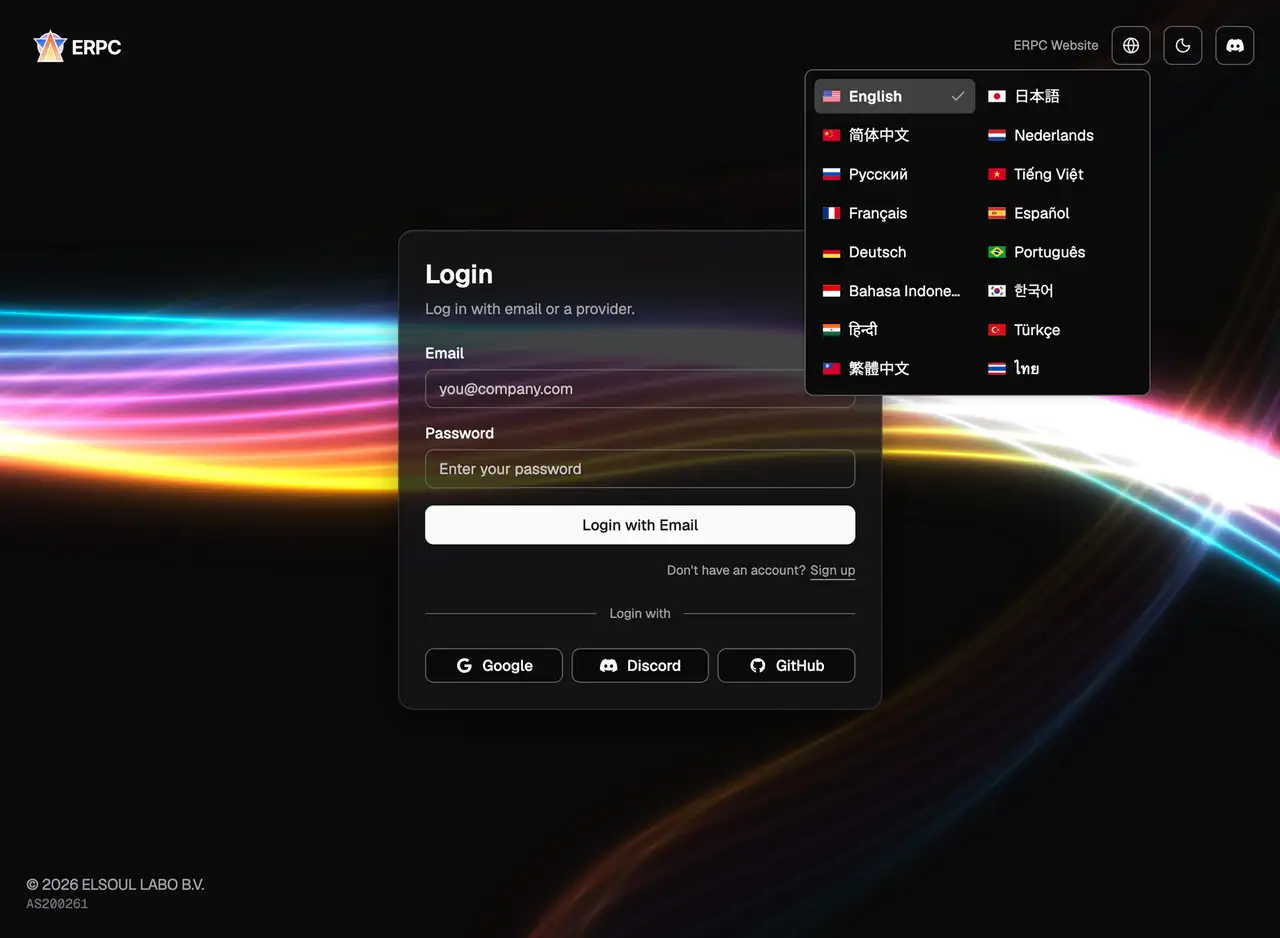
With this update, both the official website (erpc.global) and the dashboard (dashboard.erpc.global) can now be used in 16 languages, as shown above. The language selector is available at the top of each screen, both on pre-login pages and inside the dashboard, so developers can switch to their native language whenever needed.
On the official website, the Solana RPC, WebSocket, Geyser gRPC, Shredstream, Direct UDP Stream, VPS, and bare metal server offerings — and the rest of the Solana-specialized infrastructure ERPC provides — can be reviewed and compared in your native language. In the dashboard, plan selection, API key management, endpoint retrieval, usage monitoring, and support ticket creation can all be completed in the same native language.
This update gives both new evaluators of ERPC and existing users more of their working time with ERPC in their native language.
Tools You Use to Configure and Operate Infrastructure Should Be Native-Language First
It may sound simple, but using a tool in a non-native language costs more effort than people typically realize. With development infrastructure such as Solana RPC, every action involves judgment: comparing plans, selecting regions, handling API keys, configuring endpoints, interpreting usage, reading error messages, and writing support requests. When each screen has to be parsed in a non-native language and translated mentally before the meaning is confirmed, the focus that should go to the actual development work is steadily eroded.
ERPC believes that, for developers building Solana applications, the ergonomics of the tools used to configure and operate infrastructure have a direct effect on operational quality. Platform response speed, proximity to the Solana network, server placement, and network routing — the "speed on the infrastructure side" — and the ability to operate confidently in your native language — the "ergonomics on the tool side" — are both required. Neither one alone is enough. This 16-language update extends that tool-side ergonomics across 16 languages.
The dashboard can look as if it sits outside the direct value of Solana applications, but as the part of the platform where the right resources are ordered, configured, and managed, it has a large effect on day-to-day usability. ERPC continues to improve the entire toolset, including the dashboard, from this perspective.
The Dashboard in 16 Languages — Order, Configure, Monitor, and Get Support in Your Native Language
In the ERPC Dashboard, developers can manage the full lifecycle of ERPC resources — including Solana RPC, WebSocket, Geyser gRPC, Shredstream, Direct UDP Stream, VPS, and bare metal servers. From a single dashboard, you can order resources, manage API keys, retrieve endpoints, monitor usage, change plans, switch between annual, monthly, and hourly billing, configure Auto top-up, and create support tickets.
With this 16-language update, every one of those operations can be completed in your native language. The labels on the plan comparison screen, the wording on order confirmations, the error messages during configuration, the metrics on the usage screen, the input fields for creating a support ticket, and the operational notices and toasts inside the dashboard — every piece of text the user encounters is rendered in the selected language.
For each language, the dashboard-specific context — plan terminology, API terminology, operational terminology, billing terminology, and support terminology — was treated with care. Consistency of wording across the UI, parallelism in calls to action, actionable next steps in error states, and natural phrasing in each language were carefully refined. The goal is for the dashboard, when opened in your native language, to read as if it were originally written in that language.
Evaluate and Compare Solana RPC in Your Native Language on the Official Website
The official website (erpc.global) also offers each product page in 16 languages, including Solana RPC plans, WebSocket, Geyser gRPC, Shredstream, Direct UDP Stream, VPS, bare metal servers, SWQoS, Pyth-compatible Price API, and Jet Analytics & Indexed RPC.
Teams evaluating ERPC for the first time can review plan structure, supported methods, available regions, billing structure, and operational characteristics in their native language. Existing users can read new feature pages and pricing announcements in their native language as they decide whether to incorporate changes into their current configuration.
Receiving information in your native language directly affects both the speed and the precision of decisions in the evaluation phase. Reducing the cost of mentally translating technical terms one by one makes it easier to focus on the decision criteria themselves.
News and Announcements Are Also Synchronized Across 16 Languages
ERPC press releases and update announcements are already published in all 16 languages in parallel. New features, pricing updates, important operational notices, and technical additions can all be read in your native language.
Context — ERPC's operational direction, the intent behind new features, the reasoning behind pricing structures, and the rationale for technical choices — is easier to absorb when read in your native language than in the English original alone. By aligning the platform's information path across 16 languages, ERPC aims to help Solana developers around the world act on ERPC with the same underlying context.
Pursuing Speed and the Full Platform Experience With Equal Intensity
ERPC works every day on the response speed of Solana RPC, WebSocket, Geyser gRPC, and Shredstream, the physical and logical distance to the Solana network, server placement, network routing, validator quality, and processing node performance. Platform speed directly affects the execution quality of Solana applications, the trading opportunities they capture, the experience of their end users, and the stability of their operations.
At the same time, ERPC treats the configuration, management, monitoring, and support experience that supports that speed with the same level of care. No matter how fast the infrastructure side responds, day-to-day operation gets heavier if the configuration required to access that speed cannot be completed comfortably in the operator's native language. Conversely, a dashboard that can be used comfortably in a native language reduces the cost of configuration iteration, the effort of ongoing operational checks, and the psychological weight of opening a support ticket.
This 16-language update is one step in advancing the pursuit of speed and the pursuit of experience at the same intensity. On development infrastructure like Solana RPC, increasing the time developers spend operating in their native language directly protects the focus required to build and run Solana applications.
The Resources You Need, Only as Much as You Need, in the Right Place
ERPC is built around the principle that every Solana application has a different ideal configuration — and that the platform should make it possible to take only the resources you need, in only the amount you need, in the place where they fit best. Solana RPC, WebSocket, Geyser gRPC, Shredstream, Direct UDP Stream, VPS, bare metal servers, SWQoS, Pyth-compatible Price API, Jet Analytics & Indexed RPC, annual, monthly, and hourly billing, and Auto top-up are all part of that flexibility.
As the number of available choices grows, so does the cost of evaluating, ordering, and configuring them. Being able to compare, order, and configure these options in a native language is the foundation that prevents this breadth of choice from becoming a burden on the ground. The 16-language update is part of an ongoing effort to keep ERPC's configurability broad while keeping it easy to operate.
We will continue to improve native-language usability in parallel with adding the features and resources our users ask for in the places where they best fit.
Zero-Distance Communication With the Solana Network, Platform-Wide Optimization for Maximum Speed
ERPC is Solana-specialized infrastructure designed to achieve maximum speed by aiming for zero-distance — minimum-latency — communication with the Solana network and optimizing the platform as a whole. HTTP RPC, WebSocket, Geyser gRPC, Shredstream, Direct UDP Stream, SWQoS, server placement, validator quality, network routing, processing node performance, and the developer experience across the official website and dashboard are all improved as a single, integrated system.
ELSOUL LABO has received approval for five consecutive years since 2022 under the Dutch government's WBSO research and development support program. We continue research and development across Solana RPC infrastructure, validator operations, real-time data delivery, historical data access, AI agent-based operations and development support, and the platform-wide multilingual user experience. The results are reflected across ERPC, SLV, SLV AI, and the AS200261 Solana-specialized data center.
This 16-language update is an improvement aimed at delivering ERPC's zero-distance, high-speed infrastructure in a form that developers around the world can operate in their native language.
Native-Language Support Tickets, Directly From the Dashboard
Support tickets can also be created and managed in your native language, directly from the ERPC Dashboard. For questions about plans, API keys, endpoints, billing, or operational guidance, you can open a ticket from the Support screen inside the dashboard and stay in the same native-language environment throughout the conversation.
The support ticket form, the ticket list, the conversation thread, status indicators, and notifications are all available in 16 languages. The goal is a flow where you can describe your situation, follow updates, and reach a resolution in the language you already use every day.
Thank you, as always, for using ERPC. We will continue to advance both zero-distance communication with the Solana network and the platform-wide native-language experience with the same level of care.
ERPC Dashboard Support: https://dashboard.erpc.global/en/user/support
Contact
For questions about ERPC plans, Solana RPC, WebSocket, Geyser gRPC, Shredstream, Direct UDP Stream, VPS, bare metal servers, SWQoS, Pyth-compatible Price API, Jet Analytics & Indexed RPC, API keys, usage, billing, annual, monthly, or hourly billing, Auto top-up, or configuration consultation, please open a support ticket from the ERPC Dashboard. You can share your situation and configuration details in your native language.
ERPC Dashboard: https://dashboard.erpc.global/en/
ERPC Dashboard Support: https://dashboard.erpc.global/en/user/support
ERPC Official Website: https://erpc.global/en/
Validators DAO Official Discord: https://discord.gg/C7ZQSrCkYR
News